Friends:
I won the nomination last night. I am delighted, humbled and overwhelmed by the personal dedication of support to my campaign. The greatest responsibility and the greatest honour a Canadian could seek, is to be a Member of Parliament. I promise that our campaign will be ethical, generous and compassionate. I believe we can win this election. If I am elected, I will do my utmost to be the best MP in the country. The next 32 days of this campaign will be intensive, demanding and gratifying. This is the work of my life.
With gratitude,
John

Liberal candidate for Okanagan-Coquihalla
Tuesday, 29 March 2011

Sunday, 27 March 2011
Listening to Michael Ignatieff
Michael Ignatieff gave a great short speech today to more than two thousand candidates and campaign workers. I know he’s an unknown quantity to many, and he’s not yet caught fire with the media. But today’s talk came from an inspirational leader and a proud Canadian. It was wonderful for us all to hear. He’s going to cut through the chaff and noise of the Conservative attack. I think we can win Okanagan-Coquihalla with a strong and imaginative local campaign, but much of our success will of course depend on the national campaign. Michael convinced me today that we Liberals will do well nationally, thank you, very well.
His words resonated because he talked about familiar things:
• Pride in Canada
• A compassionate nation with equality and fairness at the centre of our politics
• Decent, respectful, principled politics
• Saying no to jets, jails, and corporate tax cuts
• Not adding tax burdens to families or working people
• Leading international action on climate change
• Re-engaging Canadians in politics – reaching out to progressive Conservatives with messages of hope, and of true fiscal conservatism
• Engaging young people in taking care of their future
• Emphasizing education, early learning and child care
• Taking this election as an opportunity to fight for the Canada we love
Hearing Michael speak today reminded me how much I believe in the fundamentally Canadian values of compassion and equity, of civil debate and compromise. I think those values resonate in all of us. We’re longing for a way to feel proud of our country’s government again.
Our nomination meeting in Okanagan-Coquihalla is on Monday, March 28th. if I am chosen as the candidate, I will work through the campaign to reach young people and old people, business people, environmentalists, people of the First Nations, new voters and old Liberals who have gone to ground in the face of the Conservative onslaught. Now’s our time to give them a reason to come out and a chance to vote for something they can believe in. And we will speak from the heart to the progressive conservatives who’ve had their party taken over and to the disaffected local Conservatives who have a new understanding of abuse of process, to the Greens, and to NDPers. Making our government better is our common cause. Voting Liberal is the way to make it happen.
It’s not often that any of us gets a chance to be part of making a big shift in the objectives of government, a big shift in the way government gets done, and big shift in our personal representation in Ottawa. But that’s what’s happening right now. Our votes have never been so important.
With gratitude,
John
His words resonated because he talked about familiar things:
• Pride in Canada
• A compassionate nation with equality and fairness at the centre of our politics
• Decent, respectful, principled politics
• Saying no to jets, jails, and corporate tax cuts
• Not adding tax burdens to families or working people
• Leading international action on climate change
• Re-engaging Canadians in politics – reaching out to progressive Conservatives with messages of hope, and of true fiscal conservatism
• Engaging young people in taking care of their future
• Emphasizing education, early learning and child care
• Taking this election as an opportunity to fight for the Canada we love
Hearing Michael speak today reminded me how much I believe in the fundamentally Canadian values of compassion and equity, of civil debate and compromise. I think those values resonate in all of us. We’re longing for a way to feel proud of our country’s government again.
Our nomination meeting in Okanagan-Coquihalla is on Monday, March 28th. if I am chosen as the candidate, I will work through the campaign to reach young people and old people, business people, environmentalists, people of the First Nations, new voters and old Liberals who have gone to ground in the face of the Conservative onslaught. Now’s our time to give them a reason to come out and a chance to vote for something they can believe in. And we will speak from the heart to the progressive conservatives who’ve had their party taken over and to the disaffected local Conservatives who have a new understanding of abuse of process, to the Greens, and to NDPers. Making our government better is our common cause. Voting Liberal is the way to make it happen.
It’s not often that any of us gets a chance to be part of making a big shift in the objectives of government, a big shift in the way government gets done, and big shift in our personal representation in Ottawa. But that’s what’s happening right now. Our votes have never been so important.
With gratitude,
John
Saturday, 26 March 2011
Conversations with Liberals
The Governor-General is going to call an election on Saturday. When we win Okanagan-Coquihalla and overturn the long Conservative dynasty here, aren’t we going to surprise the nation? And we’re going to simply astonish the Conservatives. What fun.
The themes for the national campaign are going to be around trust, transparency, and the economy – all areas where the Tory record doesn’t bring much credit, and where the national party is going to focus its attention. Here in the riding, I’ve learned a lot from conversations with people about important ways to bring back our pride in our country. Many have told me about health care, education, stealth fighters and mega-prisons, the environment, fiscal management and, of course, about renewing trust. Above all is a hope that we can bring back a sense of ourselves as compassionate people who care about fairness, poverty and equity as well as encouraging success. It’s no coincidence that these are in our national platform – we are Liberals, after all. Here are some thoughts inspired by these conversations.
Post-Secondary Education
Like so much right-wing rhetoric, we’re being trained to think of post-secondary education as a commercial venture – simple job training. The Conservatives like to follow models like this which have already failed in the Unites States. There, student debt is just a way to buy a job. But education is not an expense to train workers – it’s an investment in citizens, the most important asset any country has. I heard from a mother who has two grown kids, university graduates, without decent jobs and with what seems to them like enormous debts. It’s a common story. How’s that to encourage others to get the learning we all need? Canada is one of the richest countries in the world – anyone who has the grades, desire and work ethic should be able to go to university. I now that’s Mr. Ignatieff’s goal, and I know it can be achieved. I know as well that the burden of student loans on individuals can be dramatically reduced at little burden to the public purse simply by not handing them over to banks at commercial rates - this is common in Europe (except now with another neo-Con government in England). If we think creatively, without doctrinaire blinders, we can work through these issues.
Health Care
I had a long talk with a charge nurse who wants to know how we’re all going to deal with each other when we elders die off at the same time as her nurses are retiring. Where are the new people in the caring professions going to come from if we don’t train them, and if we don’t hold the jobs in high public esteem? Where are the support staff and home care professionals going to come from to help us care for each other? None of these questions has a simple answer. What is clear, though, is that the belief that all will be worked out if we move more and more of this to “the market” is not only simplistic, it’s just wrong. Delivery of health services is a provincial responsibility, but the federal government can lead in lots of ways – early childhood nutrition, education again and again, incentives to allow people to care for loved ones at home – investments like these will lead to reduced health care costs and more satisfying lives.
Prisons, Social Investment, Poverty
A drug and alcohol counsellor and child protection officer in our riding told me about the grave difficulties faced by poor single mothers and about the lack of useful help for people with addictions. Again, we’re following a path well-worn in the US. Locking up drug addicts and the mentally ill is not a humane way to treat human beings with medical problems. When our great-grandchildren look back on policies like these, they won’t be able to tell them apart from the horrible asylums of the past, with people with dementia, schizophrenia, bipolar disorder and the rest chained to walls and fed by keepers. There is no evidence anywhere in the world that a punitive approach to crime or to addiction, and certainly to mental illness, has any positive effect. And blaming poor people for their poverty doesn’t help them not to be poor. Mentally ill people need care, drug addicts need help, desperately poor people need assistance to get back on their feet. You bet, there are violent criminals and bad guys out there, and of course they should be taken out of circulation. But 18% of the prison population in Canada are First Nations people, with few ways out of the poverty trap, and 16% are mentally ill, with no help at all inside the slammer. Again, this is not “Liberal big spending”, just re-allocation of existing resources to productive means. Take 34% of the money for new prisons and use it as a social investment in people, rather than against them. Then there would be tons of space for the really bad guys. Above all, let’s stop treating people with problems as if they were the enemies of the economically efficient, and help them as members of what Mr. Trudeau called the “Just Society”.
Of course, anything about policy in one paragraph is bound to be simplistic (although not as simplistic as the 8-second sound bites people get to explain their views on TV). I’d love to have your comments, criticism or new information – just comment on this blog or Facebook page or respond to this email and I’ll get back to you.
The themes for the national campaign are going to be around trust, transparency, and the economy – all areas where the Tory record doesn’t bring much credit, and where the national party is going to focus its attention. Here in the riding, I’ve learned a lot from conversations with people about important ways to bring back our pride in our country. Many have told me about health care, education, stealth fighters and mega-prisons, the environment, fiscal management and, of course, about renewing trust. Above all is a hope that we can bring back a sense of ourselves as compassionate people who care about fairness, poverty and equity as well as encouraging success. It’s no coincidence that these are in our national platform – we are Liberals, after all. Here are some thoughts inspired by these conversations.
Post-Secondary Education
Like so much right-wing rhetoric, we’re being trained to think of post-secondary education as a commercial venture – simple job training. The Conservatives like to follow models like this which have already failed in the Unites States. There, student debt is just a way to buy a job. But education is not an expense to train workers – it’s an investment in citizens, the most important asset any country has. I heard from a mother who has two grown kids, university graduates, without decent jobs and with what seems to them like enormous debts. It’s a common story. How’s that to encourage others to get the learning we all need? Canada is one of the richest countries in the world – anyone who has the grades, desire and work ethic should be able to go to university. I now that’s Mr. Ignatieff’s goal, and I know it can be achieved. I know as well that the burden of student loans on individuals can be dramatically reduced at little burden to the public purse simply by not handing them over to banks at commercial rates - this is common in Europe (except now with another neo-Con government in England). If we think creatively, without doctrinaire blinders, we can work through these issues.
Health Care
I had a long talk with a charge nurse who wants to know how we’re all going to deal with each other when we elders die off at the same time as her nurses are retiring. Where are the new people in the caring professions going to come from if we don’t train them, and if we don’t hold the jobs in high public esteem? Where are the support staff and home care professionals going to come from to help us care for each other? None of these questions has a simple answer. What is clear, though, is that the belief that all will be worked out if we move more and more of this to “the market” is not only simplistic, it’s just wrong. Delivery of health services is a provincial responsibility, but the federal government can lead in lots of ways – early childhood nutrition, education again and again, incentives to allow people to care for loved ones at home – investments like these will lead to reduced health care costs and more satisfying lives.
Prisons, Social Investment, Poverty
A drug and alcohol counsellor and child protection officer in our riding told me about the grave difficulties faced by poor single mothers and about the lack of useful help for people with addictions. Again, we’re following a path well-worn in the US. Locking up drug addicts and the mentally ill is not a humane way to treat human beings with medical problems. When our great-grandchildren look back on policies like these, they won’t be able to tell them apart from the horrible asylums of the past, with people with dementia, schizophrenia, bipolar disorder and the rest chained to walls and fed by keepers. There is no evidence anywhere in the world that a punitive approach to crime or to addiction, and certainly to mental illness, has any positive effect. And blaming poor people for their poverty doesn’t help them not to be poor. Mentally ill people need care, drug addicts need help, desperately poor people need assistance to get back on their feet. You bet, there are violent criminals and bad guys out there, and of course they should be taken out of circulation. But 18% of the prison population in Canada are First Nations people, with few ways out of the poverty trap, and 16% are mentally ill, with no help at all inside the slammer. Again, this is not “Liberal big spending”, just re-allocation of existing resources to productive means. Take 34% of the money for new prisons and use it as a social investment in people, rather than against them. Then there would be tons of space for the really bad guys. Above all, let’s stop treating people with problems as if they were the enemies of the economically efficient, and help them as members of what Mr. Trudeau called the “Just Society”.
Of course, anything about policy in one paragraph is bound to be simplistic (although not as simplistic as the 8-second sound bites people get to explain their views on TV). I’d love to have your comments, criticism or new information – just comment on this blog or Facebook page or respond to this email and I’ll get back to you.
Monday, 21 March 2011
Better Than Fighters
Over the last while, I have been fortunate to hear from people about various topics: health care, the arts, agriculture, secrecy, dishonesty, business, the environment, immigration, education, and others. We all see any number of things to do better.
We’ve shared our displeasure at the government’s intended $30 billion purchase of stealth fighters. Some are critical that the government wants to buy the fighters through a sole-source bid, with no competition allowed. It`s not a good way to do business. In this case it’s a natural result of Canada being a partner since 1997 in funding and developing components for the “Joint Strike Fighter”, through a contract given to Lockheed-Martin. The F35 we’ve been part of building comes from only one company, and we committed to buying it in 2006. So the real question is not whether we should deal with a single supplier, but whether it’s in the country’s best interests to continue with the program at all?
I believe our military money should be focused on more obvious needs, and our job-creation spending on more useful and peaceable products.
Wikipedia says:
As for jobs, an industrial strategy based on the offensive arms trade doesn’t fit with the Canada I want to work towards. Building fighters is a very high-tech but very old-fashioned way to support industry. We could use the government’s buying power to encourage development and manufacture of helpful peaceful tools with better effect. If the government were to commit anything like this $30 billion to buying advanced environmental technologies, imagine the critical demand for industry and entrepreneurs, and the new economic activity and useful innovation that would result. The fine scientists and technicians who now work on the fighter project would be wonderful resources for science, technology, and management. We’d make great strides towards reducing waste and pollution, and fossil fuel dependency and carbon loading. We’d be working to solve the most pressing problems of the world. We’d be doing good Canadian work.
I would find it helpful to hear your thoughts about this. If you’d like to, please comment here or on Facebook.
We’ve shared our displeasure at the government’s intended $30 billion purchase of stealth fighters. Some are critical that the government wants to buy the fighters through a sole-source bid, with no competition allowed. It`s not a good way to do business. In this case it’s a natural result of Canada being a partner since 1997 in funding and developing components for the “Joint Strike Fighter”, through a contract given to Lockheed-Martin. The F35 we’ve been part of building comes from only one company, and we committed to buying it in 2006. So the real question is not whether we should deal with a single supplier, but whether it’s in the country’s best interests to continue with the program at all?
I believe our military money should be focused on more obvious needs, and our job-creation spending on more useful and peaceable products.
Wikipedia says:
“The F-35 is required to be . . . effective . . . in air-to-air combat, . . . air-to-ground combat, andThat makes a fine offensive weapon, but it’s little help for anything else. I believe our defence should be oriented to the coasts, and focused on the north. Climate change is opening up the Arctic: to protect our environment and reinforce our sovereignty, we need ice-breaking capacity and long-range patrol aircraft. Internationally, we’re still short on heavy-lift capability to rapidly deploy our people and resources. Our personnel are some of the best in the world at combat, peacekeeping and disaster relief – they need a better ability to get to the scene. Our business is to provide support for their useful activities, not for tactical air combat and suppression of air defences. We can provide better help to the military without the fighter program.
. . . suppression of air defenses . “
As for jobs, an industrial strategy based on the offensive arms trade doesn’t fit with the Canada I want to work towards. Building fighters is a very high-tech but very old-fashioned way to support industry. We could use the government’s buying power to encourage development and manufacture of helpful peaceful tools with better effect. If the government were to commit anything like this $30 billion to buying advanced environmental technologies, imagine the critical demand for industry and entrepreneurs, and the new economic activity and useful innovation that would result. The fine scientists and technicians who now work on the fighter project would be wonderful resources for science, technology, and management. We’d make great strides towards reducing waste and pollution, and fossil fuel dependency and carbon loading. We’d be working to solve the most pressing problems of the world. We’d be doing good Canadian work.
I would find it helpful to hear your thoughts about this. If you’d like to, please comment here or on Facebook.
Sunday, 13 March 2011
Stockwell Day will not run again.
Stockwell Day has announced that he will not be running again. Who knows, maybe I scared him off?
When I began this campaign, I was clear I was going to win the riding in two elections. Now, at the closing of the Day, I know we'll do it in one. Same strategy, quicker tactical work and we start right now.
I want to thank Mr. Day for his years of dedication to what he believes to be the in the public interest. I have had the pleasure of meeting many Members of Parliament over the years, from all parties. There are a few for whom I have no respect and a few who are clearly in “the game” for personal aggrandizement or because their egos and swelled heads are already too big for their hats. But almost all of the people I have met who devote their lives to Parliament do it because they sincerely believe that they are working to advance the public good. We need to acknowledge that public service, and especially the life of an MP, is difficult, demanding, and especially hard on families. And I extend my gratitude to Mr. Day for his work, his diligence and his dedication.
This is not to deny that I believe that Mr. Day and his Reform/Canadian Alliance/”Conservative” colleagues to have been wrong-headed and misdirected from the outset. I believe their electoral tactics and disrespect of parliamentary rules and conventions have done a disservice to our democracy. I am committed to rebuilding the government of Canada so that it earns again our confidence and trust.
I have been asked what motivates me to be politically active and why I seek this job. It’s simple, really. To serve the government of Canada has always seemed to me to be the highest honour as citizen could seek, and I have been preparing to do so for most of my life. I have well developed and articulated positions on many issues of Canadian public policy - but these policy goals are only effects of my purpose rather than the purpose itself. I have always tried to live a right life. This was clarified for me twelve years ago, when I was privileged to attend a lecture by the Dalai Lama. He told me, along with several thousand others, not to lose sight of the goal of a human life: to be happy. And he told us the way to be happy: “Do no harm; do good; do good for others.” That simple observation changed the way I think, feel and act. Money, power, status – these need not be our main drivers. Happiness is the goal we all seek. And if that’s all we need - to do no harm, do good, and do good for others - then we can all find it. This is my motivation.
Political office is the right way, now, for me to live to those ideals. And with all the respect due to Mr. Day, Mr. Strahl, and the rest of the Conservatives, it’s time to bring those ideals back to Canadian politics. I will not support ministers, Liberal or other, who breach their responsibilities – that is doing harm. I will not be part of divide-and-conquer tactics – that’s not doing good. I will argue with force and effect for broad rather than narrow political agendas, for consideration of the public at large rather than attention focussed only on “core” voting groups – that’s not doing good for others. The rules are simple, unambiguous, and easy to follow.
Time is short. Our nomination meeting is on Tuesday March 28, by which time we may already be well into an election. So, over the next couple of weeks, I will be working both to win the nomination and to generate momentum for the campaign. Many people in the riding have asked about my feelings on public issues – I will use this blog to repeat my responses. You will see that I take a different approach to federal politics, based on the principles I live by. If you are a Liberal in Okanagan-Coquihalla, I ask for your support at the nomination meeting, and I`d love it if you would join the election team. I am open and ready for your questions and comments – please email me at kidder@telus.net, phone 250-453-9590, or add a note to the discussion on this blog or on my Facebook page at www.facebook.com/John.Kidder.Campaign.
When I began this campaign, I was clear I was going to win the riding in two elections. Now, at the closing of the Day, I know we'll do it in one. Same strategy, quicker tactical work and we start right now.
I want to thank Mr. Day for his years of dedication to what he believes to be the in the public interest. I have had the pleasure of meeting many Members of Parliament over the years, from all parties. There are a few for whom I have no respect and a few who are clearly in “the game” for personal aggrandizement or because their egos and swelled heads are already too big for their hats. But almost all of the people I have met who devote their lives to Parliament do it because they sincerely believe that they are working to advance the public good. We need to acknowledge that public service, and especially the life of an MP, is difficult, demanding, and especially hard on families. And I extend my gratitude to Mr. Day for his work, his diligence and his dedication.
This is not to deny that I believe that Mr. Day and his Reform/Canadian Alliance/”Conservative” colleagues to have been wrong-headed and misdirected from the outset. I believe their electoral tactics and disrespect of parliamentary rules and conventions have done a disservice to our democracy. I am committed to rebuilding the government of Canada so that it earns again our confidence and trust.
I have been asked what motivates me to be politically active and why I seek this job. It’s simple, really. To serve the government of Canada has always seemed to me to be the highest honour as citizen could seek, and I have been preparing to do so for most of my life. I have well developed and articulated positions on many issues of Canadian public policy - but these policy goals are only effects of my purpose rather than the purpose itself. I have always tried to live a right life. This was clarified for me twelve years ago, when I was privileged to attend a lecture by the Dalai Lama. He told me, along with several thousand others, not to lose sight of the goal of a human life: to be happy. And he told us the way to be happy: “Do no harm; do good; do good for others.” That simple observation changed the way I think, feel and act. Money, power, status – these need not be our main drivers. Happiness is the goal we all seek. And if that’s all we need - to do no harm, do good, and do good for others - then we can all find it. This is my motivation.
Political office is the right way, now, for me to live to those ideals. And with all the respect due to Mr. Day, Mr. Strahl, and the rest of the Conservatives, it’s time to bring those ideals back to Canadian politics. I will not support ministers, Liberal or other, who breach their responsibilities – that is doing harm. I will not be part of divide-and-conquer tactics – that’s not doing good. I will argue with force and effect for broad rather than narrow political agendas, for consideration of the public at large rather than attention focussed only on “core” voting groups – that’s not doing good for others. The rules are simple, unambiguous, and easy to follow.
Time is short. Our nomination meeting is on Tuesday March 28, by which time we may already be well into an election. So, over the next couple of weeks, I will be working both to win the nomination and to generate momentum for the campaign. Many people in the riding have asked about my feelings on public issues – I will use this blog to repeat my responses. You will see that I take a different approach to federal politics, based on the principles I live by. If you are a Liberal in Okanagan-Coquihalla, I ask for your support at the nomination meeting, and I`d love it if you would join the election team. I am open and ready for your questions and comments – please email me at kidder@telus.net, phone 250-453-9590, or add a note to the discussion on this blog or on my Facebook page at www.facebook.com/John.Kidder.Campaign.
Saturday, 26 February 2011
Living in the real world of climate change
In my quest for the last ten signatures on my nomination papers (if you’d like to support me, and you’re a member of the Liberal Party of Canada, click on Nomination Form; if you’re not yet a member, it costs $10 at Membership Forms), I was talking in Penticton with a smart young local winemaker. She told me her biggest single political concern was that the federal government was not addressing environmental issues. We talked about our glorious dryland environment, and the care it took to grow grapes and grasses, and to keep the land healthy. We talked about the warming of the earth. We talked about our responsibilities, to her children and to my grandchildren.
I came home and looked up what the Prime Minister had to say:
“Kyoto is essentially a socialist scheme to suck money out of wealth-producing nations. . . . It focuses on carbon dioxide, which is essential to life, rather than upon pollutants.”
Minister Day has joked:
“Maybe all my constituents living high up on the West Bench, or Lakeview Heights, or the hills of Logan Lake will soon be sitting on lakeside property as one of the many benefits of global warming”.
Here in the dry Interior of BC we know differently. We live in, we see and feel the changes, and we’re concerned. We are concerned about the masses of dead pine trees and the millions of hectares of dead timber to be fuel for the fires to come, we’re concerned about groundwater and snowpack and our rivers, we see grapes being grown farther and farther north. Because we know these things right here and right now, we feel them strongly. Instead of being a voice of denial, we want to talk out loud about the coming storms.
The data is undeniable – humans are putting carbon into the atmosphere at a rate which is causing systemic changes in climate systems. We are all aware of that. If we kept business accounts for the planet, it would be clear that we’ve been stripping assets off the balance sheet for years to pad the income statement. We convince ourselves we’re getting richer every day by consuming the wealth around us. It’s like being in England during the second world war, burning the furniture to keep warm.
It’s past the time we chose different paths, to reduce net carbon emissions worldwide, and to adapt to and mitigate the damage from the changes that are already inevitable. Canadians should be among the leaders in looking for solutions – because of our climate and geography, we use more energy per person than any other country in the world. And the solutions we come up with – despite what you hear from the moneyed classes that we can’t compete with Americans – will be among the best in the world. We are smart tough people, and we’ve been dealing with hard problems since we began this country here in the frozen north. Our government needs to encourage this, not to write it off because they think it may cost us a half-point of GDP growth from the tarsands. For example, without changing laws or regulations or taxes, but just by changing its buying practices, the federal government can shift demand away from carbon and provide critical new demand to home-grown suppliers to produce all sorts of useful technologies and products.
We are all good people at heart. We know we cannot disclaim our responsibilities towards our neighbours, or to people far away. No matter what we do or how hard we work, no matter what “solutions” may be found, we know that over the next sixty to eighty years tens of millions of people will be displaced by rising water; they will move to places where tens of millions of people already live. It’s happening now – the inhabitants of the Maldive Islands are trying to buy a new homeland, because theirs will be underwater soon – and it’s not going to get better. What are going to be worldwide strategies for adaptation and mitigation? How can we best assist with formulating them? What can individuals do alone and in our communities?
We, with our direct experience and felt sense of the changes, can add a sense of importance and urgency to these things. Our nation has become an international joke – a repeat winner of the Dinosaur Award. We used to have reasons to feel proud out there in the world, rather than being a bit ashamed. Never before could anyone be embarrassed simply by being Canadian.
From right here where it’s happening, we can lead discussions and policy choices nationally, take such action locally as we can and must, and help Canada regain its place among the progressive nations of the world.
___________________________________________
Please feel free and encouraged to add comments in the boxes below and forward to anyone you feel would be interested in this dialogue.
With gratitude,
John
I came home and looked up what the Prime Minister had to say:
Minister Day has joked:
Here in the dry Interior of BC we know differently. We live in, we see and feel the changes, and we’re concerned. We are concerned about the masses of dead pine trees and the millions of hectares of dead timber to be fuel for the fires to come, we’re concerned about groundwater and snowpack and our rivers, we see grapes being grown farther and farther north. Because we know these things right here and right now, we feel them strongly. Instead of being a voice of denial, we want to talk out loud about the coming storms.
The data is undeniable – humans are putting carbon into the atmosphere at a rate which is causing systemic changes in climate systems. We are all aware of that. If we kept business accounts for the planet, it would be clear that we’ve been stripping assets off the balance sheet for years to pad the income statement. We convince ourselves we’re getting richer every day by consuming the wealth around us. It’s like being in England during the second world war, burning the furniture to keep warm.
It’s past the time we chose different paths, to reduce net carbon emissions worldwide, and to adapt to and mitigate the damage from the changes that are already inevitable. Canadians should be among the leaders in looking for solutions – because of our climate and geography, we use more energy per person than any other country in the world. And the solutions we come up with – despite what you hear from the moneyed classes that we can’t compete with Americans – will be among the best in the world. We are smart tough people, and we’ve been dealing with hard problems since we began this country here in the frozen north. Our government needs to encourage this, not to write it off because they think it may cost us a half-point of GDP growth from the tarsands. For example, without changing laws or regulations or taxes, but just by changing its buying practices, the federal government can shift demand away from carbon and provide critical new demand to home-grown suppliers to produce all sorts of useful technologies and products.
We are all good people at heart. We know we cannot disclaim our responsibilities towards our neighbours, or to people far away. No matter what we do or how hard we work, no matter what “solutions” may be found, we know that over the next sixty to eighty years tens of millions of people will be displaced by rising water; they will move to places where tens of millions of people already live. It’s happening now – the inhabitants of the Maldive Islands are trying to buy a new homeland, because theirs will be underwater soon – and it’s not going to get better. What are going to be worldwide strategies for adaptation and mitigation? How can we best assist with formulating them? What can individuals do alone and in our communities?
We, with our direct experience and felt sense of the changes, can add a sense of importance and urgency to these things. Our nation has become an international joke – a repeat winner of the Dinosaur Award. We used to have reasons to feel proud out there in the world, rather than being a bit ashamed. Never before could anyone be embarrassed simply by being Canadian.
From right here where it’s happening, we can lead discussions and policy choices nationally, take such action locally as we can and must, and help Canada regain its place among the progressive nations of the world.
___________________________________________
Please feel free and encouraged to add comments in the boxes below and forward to anyone you feel would be interested in this dialogue.
With gratitude,
John
Monday, 21 February 2011
Up and Running
Welcome ~
John Sidney Kidder is my name (please call me John).
I am seeking support to win the Liberal nomination for the federal riding of Okanagan - Coquihalla. With less than a week to sign up memberships to the Liberal party and then to join me at the nomination meeting expected on Tuesday, March 15th, I need your help today. If you, family, friends or colleagues from the riding would like to help nominate me by joining the Liberal Party to renew or to begin a new membership, please click on Membership. Then please carry on to my Nomination form to nominate me.
I am opposed to many of the directions our government is taking. In almost every policy decision, I see our government tending towards secrecy rather than openness, division rather than inclusion, authority rather than freedom, private interests rather than public. I see ideologically-based political tactics intended to ensure electoral success, rather than a strategy for sound government. I want to be a part of replacing this government with one that better reflects Canada and Canadians.
Many people have asked "Why would you run against Stockwell Day, a sitting minister - you are bound to lose"? I answer: because I can, and because I have a clear focused strategy to defeat him in two elections. When I do, I will serve and represent my constituents in parliament with strong determination, clear policy decisions and passionate drive. I will do this work with kindness, goodness and great care, holding the personal, business and community needs of others as my first order of business.
I was born in the North, grew up in the East and came of age in the West. I have been privileged to live, be educated and work all across this country. My father was a Progressive Conservative miner, my mother was a CCF/NDP history teacher, so I come by my centrist Liberal roots honestly. We moved often from towns to mining camps to cities - since I was young I have felt a great loyalty to all of Canada, and have aspired to the honour serving as an MP would bring.
My background makes me familiar with much of the country, and helps me to be understanding of and sympathetic to many Canadian issues. My French is no longer perfect, but will come back with practice. My many jobs and careers help me to hear clearly and talk openly with people from all walks of life. From businessman to bureaucrat, from working cowboy to software developer, as fish plant worker, governance expert, technology pioneer and folk festival director, I have done and loved them all. I have helped individuals and agencies reach consensus on complex issues of environment and land use, and on contentious matters in both community and political organizations – these confirm my desire and my abilities to be engaged in constituency work and policy development. My education is broad and deep; years of university and graduate study, and more informal and self-taught. I have been a member of the Liberal party of Canada since 1980, and have found great pleasure in working on many federal and provincial campaigns and leadership races for some of our country’s finest men and women.
I am a son, eldest brother to five siblings, uncle to many, father of three grown children, grandfather of three. I was married for 32 years to my wife Siri, who died from cancer in 2009. In my spare time I read, write, ride, play guitars and sing, and maintain 10 acres at Ashcroft in the dry interior of BC.
I believe that it is the duty of every citizen to do what he or she can to contribute to the public good within the capacity each holds to do so. Each of us makes a contribution in our way - when we raise our children with a sense of what is right and wrong, when we are fair and open in our work and recreation, when we care for family, neighbours and friends in time of need, when we volunteer our resources for community events and organizations, and when we study our options and make choices about our governments and their representatives. Our actions affect the society we live in. And whether it's a full-time job, a lifetime dedication, or simply the criteria we use when choosing a course of action, we all have a responsibility to do our work as citizens. Our civil society and our democracy rests on us taking that duty seriously.
It would be an honour to be a Member of the House of Commons of Canada. The House, in government or opposition, is at this time in my life the best place for me to use the skills I have worked to build. Although I have not yet held elected office, I have trained for this job - travelled, studied, talked, listened and worked at it for years. I have done my homework. Now, the essential public trust between government and citizens is suffering. There is an urgent need for action to help restore integrity where it is lacking. Especially now, I know I can be of real assistance.
I know I would make a true, thoughtful and lasting contribution to our country. I have always kept the public good front and centre, and have tried to live to the highest possible personal and political ethical standards. I will continue to do so for the rest of my days. “Home training will tell”, my mother used to say. I couldn't do it any other way.
I would be delighted to speak with any members of the riding who may be able to assist.
With gratitude,
John
T 250.453.9590
M 604.626.8184
E kidder@telus.net
F Facebook
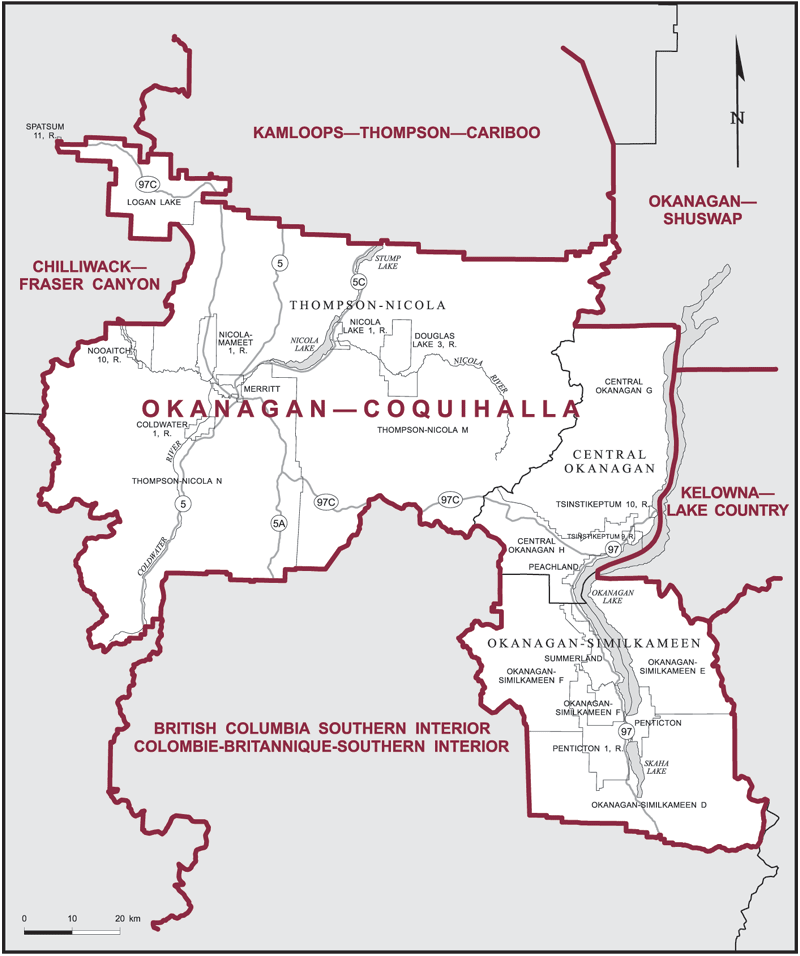
The Okanagan-Coquihalla electoral district includes Okanagan Falls, Penticton, Merritt, Summerland, Logan Lake, West Kelowna and Peachland and the surrounding areas. Click Electoral District Map for a map of the riding.
Party Membership on-line registration: Membership Forms
Nomination Forms: Nomination Form
For information regarding the Okanagan-Coquihalla Federal Liberal Electoral District Association, please contact Christine Elder, Membership Chair, at elderhudson@shaw.ca, or on 250.494.8548.
John Sidney Kidder is my name (please call me John).
I am seeking support to win the Liberal nomination for the federal riding of Okanagan - Coquihalla. With less than a week to sign up memberships to the Liberal party and then to join me at the nomination meeting expected on Tuesday, March 15th, I need your help today. If you, family, friends or colleagues from the riding would like to help nominate me by joining the Liberal Party to renew or to begin a new membership, please click on Membership. Then please carry on to my Nomination form to nominate me.
I am opposed to many of the directions our government is taking. In almost every policy decision, I see our government tending towards secrecy rather than openness, division rather than inclusion, authority rather than freedom, private interests rather than public. I see ideologically-based political tactics intended to ensure electoral success, rather than a strategy for sound government. I want to be a part of replacing this government with one that better reflects Canada and Canadians.
Many people have asked "Why would you run against Stockwell Day, a sitting minister - you are bound to lose"? I answer: because I can, and because I have a clear focused strategy to defeat him in two elections. When I do, I will serve and represent my constituents in parliament with strong determination, clear policy decisions and passionate drive. I will do this work with kindness, goodness and great care, holding the personal, business and community needs of others as my first order of business.
I was born in the North, grew up in the East and came of age in the West. I have been privileged to live, be educated and work all across this country. My father was a Progressive Conservative miner, my mother was a CCF/NDP history teacher, so I come by my centrist Liberal roots honestly. We moved often from towns to mining camps to cities - since I was young I have felt a great loyalty to all of Canada, and have aspired to the honour serving as an MP would bring.
My background makes me familiar with much of the country, and helps me to be understanding of and sympathetic to many Canadian issues. My French is no longer perfect, but will come back with practice. My many jobs and careers help me to hear clearly and talk openly with people from all walks of life. From businessman to bureaucrat, from working cowboy to software developer, as fish plant worker, governance expert, technology pioneer and folk festival director, I have done and loved them all. I have helped individuals and agencies reach consensus on complex issues of environment and land use, and on contentious matters in both community and political organizations – these confirm my desire and my abilities to be engaged in constituency work and policy development. My education is broad and deep; years of university and graduate study, and more informal and self-taught. I have been a member of the Liberal party of Canada since 1980, and have found great pleasure in working on many federal and provincial campaigns and leadership races for some of our country’s finest men and women.
I am a son, eldest brother to five siblings, uncle to many, father of three grown children, grandfather of three. I was married for 32 years to my wife Siri, who died from cancer in 2009. In my spare time I read, write, ride, play guitars and sing, and maintain 10 acres at Ashcroft in the dry interior of BC.
I believe that it is the duty of every citizen to do what he or she can to contribute to the public good within the capacity each holds to do so. Each of us makes a contribution in our way - when we raise our children with a sense of what is right and wrong, when we are fair and open in our work and recreation, when we care for family, neighbours and friends in time of need, when we volunteer our resources for community events and organizations, and when we study our options and make choices about our governments and their representatives. Our actions affect the society we live in. And whether it's a full-time job, a lifetime dedication, or simply the criteria we use when choosing a course of action, we all have a responsibility to do our work as citizens. Our civil society and our democracy rests on us taking that duty seriously.
It would be an honour to be a Member of the House of Commons of Canada. The House, in government or opposition, is at this time in my life the best place for me to use the skills I have worked to build. Although I have not yet held elected office, I have trained for this job - travelled, studied, talked, listened and worked at it for years. I have done my homework. Now, the essential public trust between government and citizens is suffering. There is an urgent need for action to help restore integrity where it is lacking. Especially now, I know I can be of real assistance.
I know I would make a true, thoughtful and lasting contribution to our country. I have always kept the public good front and centre, and have tried to live to the highest possible personal and political ethical standards. I will continue to do so for the rest of my days. “Home training will tell”, my mother used to say. I couldn't do it any other way.
I would be delighted to speak with any members of the riding who may be able to assist.
With gratitude,
John
T 250.453.9590
M 604.626.8184
E kidder@telus.net
F Facebook
The Okanagan-Coquihalla electoral district includes Okanagan Falls, Penticton, Merritt, Summerland, Logan Lake, West Kelowna and Peachland and the surrounding areas. Click Electoral District Map for a map of the riding.
Party Membership on-line registration: Membership Forms
Nomination Forms: Nomination Form
For information regarding the Okanagan-Coquihalla Federal Liberal Electoral District Association, please contact Christine Elder, Membership Chair, at elderhudson@shaw.ca, or on 250.494.8548.
Subscribe to:
Posts (Atom)